
How better logistics decisions keep industrial operations on track
Industrial logistics requires balancing technical constraints, operational deadlines, and execution risks. Understanding which requirements are fixed, how different stages affect one another, and when alternatives remain viable helps logistics teams make more informed decisions when moving machinery, equipment, and industrial components.
A machine destined for a planned plant expansion and a replacement component needed for urgent maintenance may both be essential to industrial operations, yet demand very different logistics strategies.
The difference goes beyond cargo specifications. Technical requirements influence how a shipment can be handled and transported, while operational priorities determine the timing and conditions its delivery must satisfy.
For logistics teams, the priority is to evaluate transportation options against technical requirements and operational commitments, identifying opportunities to optimize without compromising execution.
Find where logistics optimization adds real value
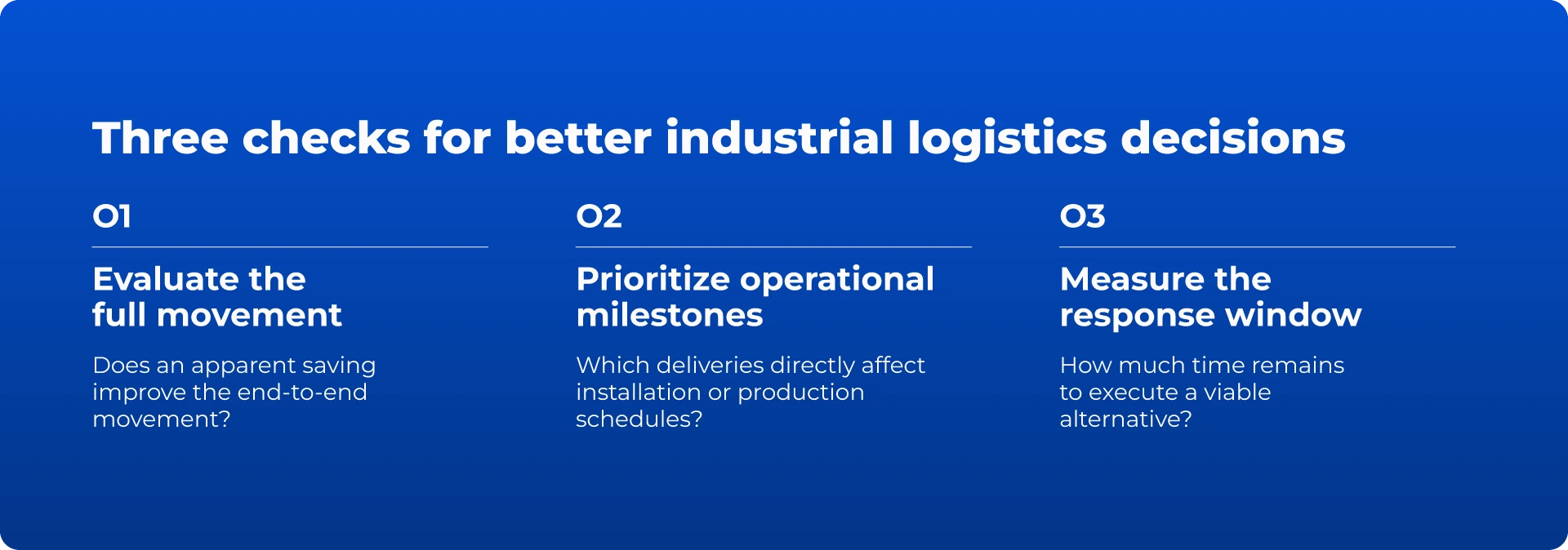
In industrial logistics, an apparent advantage in cost or transit time only creates value when it supports the technical requirements and execution conditions of the complete movement.
Consider oversized machinery being shipped by sea for a planned plant expansion. Its dimensions, weight distribution, and lifting requirements call for appropriate equipment, handling methods, and route conditions to ensure safe transportation. These technical requirements must be met in any proposed logistics solution.
With installation scheduled well in advance, the logistics team may have room to explore cost-saving opportunities, such as selecting a destination port with lower handling charges. However, that port may present bridge clearance restrictions along the inland route, requiring a longer detour or a different trailer configuration. These adjustments could involve additional permits, specialized equipment, and coordination time, potentially offsetting the initial savings or reducing the margin available before installation.
The comparison should therefore extend beyond individual transportation or port charges. Assessing each alternative through its route feasibility, technical resources, permit lead times, total costs to the intended delivery point, and compatibility with the installation window helps establish its actual value. Cost comparisons should also account for the agreed delivery responsibilities to ensure the alternatives are evaluated on an equivalent basis.
Plan around dependencies not just delivery dates
Meeting individual shipment deadlines does not necessarily mean the overall logistics schedule supports the production plan.
Consider a new production line requiring machinery, automation components, and specialized tooling arriving in separate shipments. Although the main equipment may be ready for dispatch first, subsequent activities depend on the arrival of other components, site readiness, and the availability of technical resources.
Working backward from installation, testing, and commissioning milestones allows logistics teams to identify which shipments must arrive first, which have greater scheduling flexibility, and which delays could affect the planned production start.
For example, a two-day delay involving an automation component could prevent critical testing within an agreed commissioning window, making expedited transportation worth evaluating. By contrast, a similar delay affecting tooling needed for a later production phase may be absorbed without changing the start-up date.
Even when a delayed component affects a critical activity, accelerating its transportation is not necessarily the best option. Adjusting the sequence of technical work may preserve the planned production start without incurring additional freight costs.
Understand the time available to respond
A shipment does not need to miss its delivery deadline for an intervention to become necessary. The more relevant question is whether enough time remains to execute an alternative before the operational commitment is affected.
Consider a critical machinery component moving internationally for scheduled maintenance. An operational delay on the first flight reduces the time available for cargo transfer at the connecting airport. Although the onward connection has not yet been missed, the revised schedule creates a risk of arriving later than planned.
The logistics team identifies a potential alternative routing, but securing capacity, arranging the transfer, preparing applicable customs documentation, and coordinating final delivery all require time. Airline booking cutoffs and the availability of connecting flights may further restrict how long that option remains viable.
The decision therefore depends on two timelines: how much time remains before the component is needed and how long the alternative would take to execute. Waiting for confirmation of a missed connection could eliminate the opportunity to recover the schedule, even if the original delivery deadline has not yet passed.
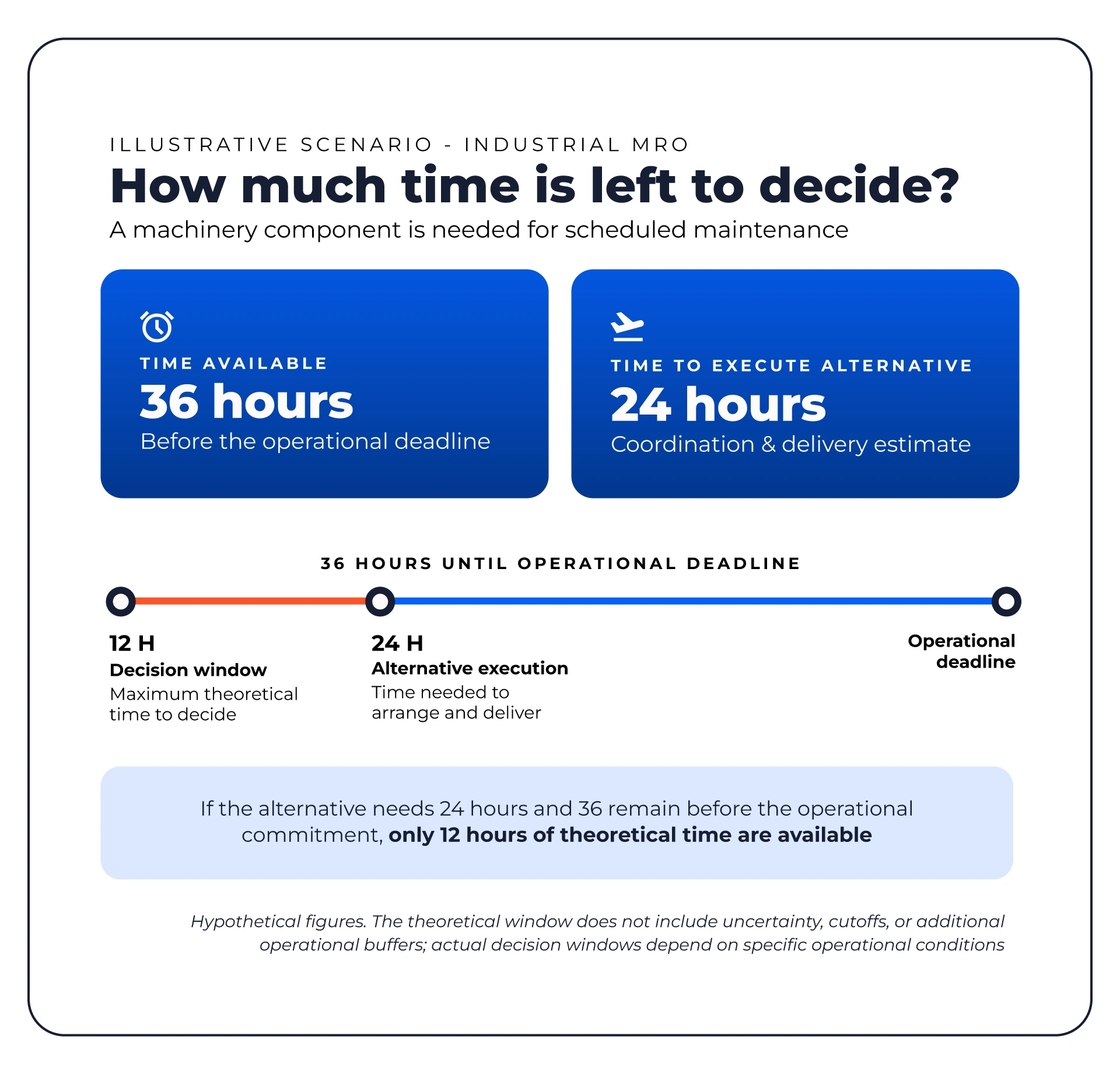
Rather than relying exclusively on shipment status or estimated arrival dates, logistics teams can establish intervention thresholds that account for execution time, operational uncertainty, and the consequences of acting too early or too late.
Making logistics decisions count
Effective industrial logistics management is not about eliminating every constraint or preparing for every possible disruption. It is about recognizing where decisions can make a meaningful difference and making choices that reflect the requirements of the cargo and the operations it supports.
At xpd global, we combine specialized knowledge of industrial cargo with the planning and responsiveness required to meet demanding production schedules. Our teams assess transportation feasibility, coordinate complex international movements, and adapt logistics strategies as conditions change, helping customers protect production continuity.
Planning logistics for industrial machinery or critical components?
Connect with our logistics specialists at info@xpdglobal.com.