
Oil & gas logistics built for operational continuity
In oil & gas logistics, the urgency of a shipment is defined by what depends on its arrival. When parts, equipment or specialized cargo are needed for maintenance, field operations or project execution, delays can quickly affect operational continuity. Time-critical logistics brings together speed, coordination and control to keep these shipments moving across complex routes and tight delivery windows.
Oil & gas companies operate in a market where logistics plans are exposed to price sensitivity and disruption around critical energy corridors. These conditions can alter routing options, timing and cost with little notice, making the movement of cargo from origin to destination only one part of the challenge.
For time-critical movements, the logistics model must remain executable as circumstances change. Pressure rarely comes from a single factor. Multiple constraints can interact throughout the shipment, narrow the available alternatives and increase the risk to the overall operation.
When several of these pressures converge around cargo tied to a fixed operational deadline, standard freight planning is no longer enough.
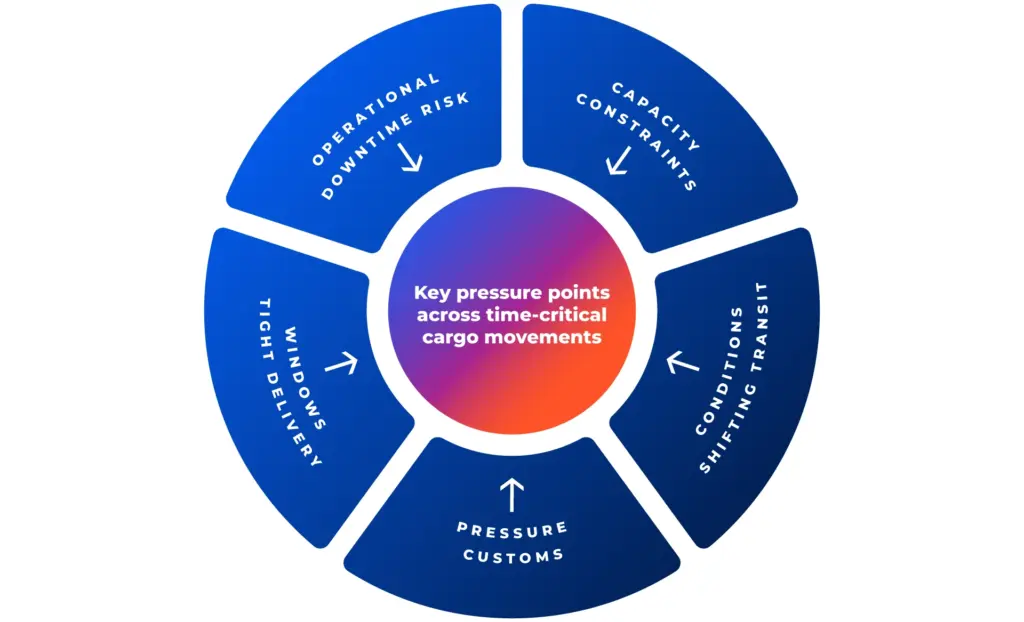
Why time-critical oil & gas logistics requires specialized coordination
Oil & gas supply chains often involve demanding cargo profiles and high-pressure operating environments. Shipments may include urgent replacement parts, heavy equipment, specialized components and materials moving through multiple transport modes, customs processes and handling points. Final delivery may also require access to industrial facilities, supply bases, remote sites or offshore operations.
These movements take place within an international transport environment exposed to strategic corridors. The U.S. Energy Information Administration identifies the Strait of Hormuz and the Strait of Malacca as two of the world’s most important oil transit chokepoints, noting that disruption across major corridors can add thousands of miles to alternative routes and affect energy markets1.
Recent disruption in the Red Sea illustrates how events affecting major maritime corridors can quickly change transportation conditions. UN Trade and Development reports that vessels that once crossed the corridor in days have had to sail for weeks around the Cape of Good Hope, contributing to longer transit times, volatile freight rates and continued pressure on ports2.
For time-critical cargo, reduced routing and capacity options can place additional pressure on onward connections and final delivery planning. Effective execution must therefore consider route exposure, cargo readiness, customs documentation, destination conditions and viable contingency options.

Time-critical logistics as an operating model
Time-critical logistics is not simply faster transportation. It is a coordinated response model designed to protect an operational deadline when the margin for delay is limited.
The process begins by understanding what the shipment must support. Cargo readiness, the required delivery window, route conditions and the consequence of a missed milestone must be assessed together before a solution is activated.
From there, the logistics team must build an executable plan. Depending on the requirement, this may involve air, expedited ground, multimodal, hand-carry or charter solutions, supported by specialized final-delivery coordination. The shortest theoretical transit time is not always the most reliable option. Capacity, cut-off times, customs readiness, transfer points and destination conditions must all support the required timeline.
Once the shipment is in motion, execution requires alignment across documentation, customs, carriers, handling teams and local delivery providers. Visibility must enable action rather than simply report location. Each milestone should show whether the plan remains viable and whether intervention is needed before the next stage is affected.
Because conditions can change during the movement, exception management must be built into the response from the outset. Alternative routes, escalation paths and clear decision ownership allow the plan to adapt without losing control of the cargo or the required delivery outcome.
The value of time-critical logistics lies in maintaining a controlled path to delivery, even when the original plan is no longer viable.
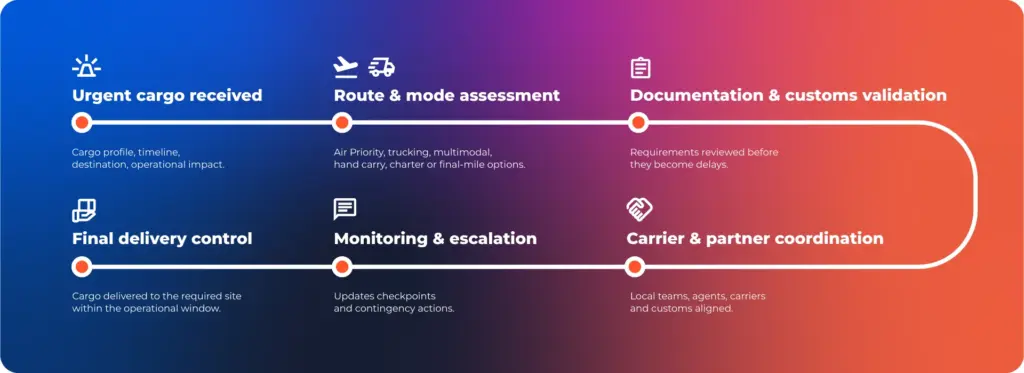
What oil & gas companies should expect from a time-critical logistics partner
For Oil & Gas companies, a time-critical logistics partner must be able to respond beyond a single shipment or transport mode. It must understand the operational priority, take ownership across multiple handoffs and maintain a viable path to delivery when the original plan is affected.
Regional capability is especially important when urgent cargo must cross different countries, regulatory environments and transportation networks before reaching an industrial facility, supply base, remote site or offshore support location. Global connectivity must therefore be supported by local execution and teams capable of responding to conditions at origin, in transit and at destination.

Across Asia Pacific, xpd global supports oil & gas companies through time-critical, cross-border, multimodal and specialized cargo solutions. Our regional teams connect international origins and destinations while coordinating transport, customs and complex final-delivery requirements across the movement.
By combining regional knowledge with global coordination, xpd global helps customers reassess alternatives when routes, capacity or local conditions change, while maintaining visibility and clear ownership. This gives Oil & Gas companies a logistics response capable of supporting equipment availability, operational resilience and the activities depending on the cargo’s arrival.
Need to keep time-critical cargo moving for your oil & gas operations?
Sources
1 U.S. Energy Information Administration, World Oil Transit Chokepoints, updated March 2026.
2 UN Trade and Development, Review of Maritime Transport 2025: Staying the Course in Turbulent
Waters, published September 24, 2025.