
In manufacturing, speed is what protects continuity when variables shift
Part 1 of the Fast, Friendly & Dedicated editorial series
This article explores why speed in modern manufacturing logistics is no longer measured in miles per hour, but in decision-making before pressure takes control.
For years, speed has long been treated as a straightforward advantage: faster production cycles, faster launches, faster responses to demand. But especially in time-sensitive production environments, the moments that truly test speed arrive after plans begin to shift, when capacity tightens, and decisions must be made before all variables are clear.
A supplier misses a delivery window. Demand is pulled forward. A corridor that felt stable days before suddenly closes. None of these situations waits for approval chains or perfect data. The clock starts immediately, and in those first moments, the difference between a contained adjustment and a cascading disruption is not how fast something moves, but how fast clear decisions are made.
When uncertainty becomes normal
Disruption is no longer an exception layered onto an otherwise stable system. It is part of the operating environment itself. Supplier reliability fluctuates. Regulatory requirements shift with limited notice. Labor markets remain tight, and infrastructure congestion has become structural rather than seasonal.
THE 13 BIGGEST SUPPLY CHAIN DISRUPTIONS SINCE 2000
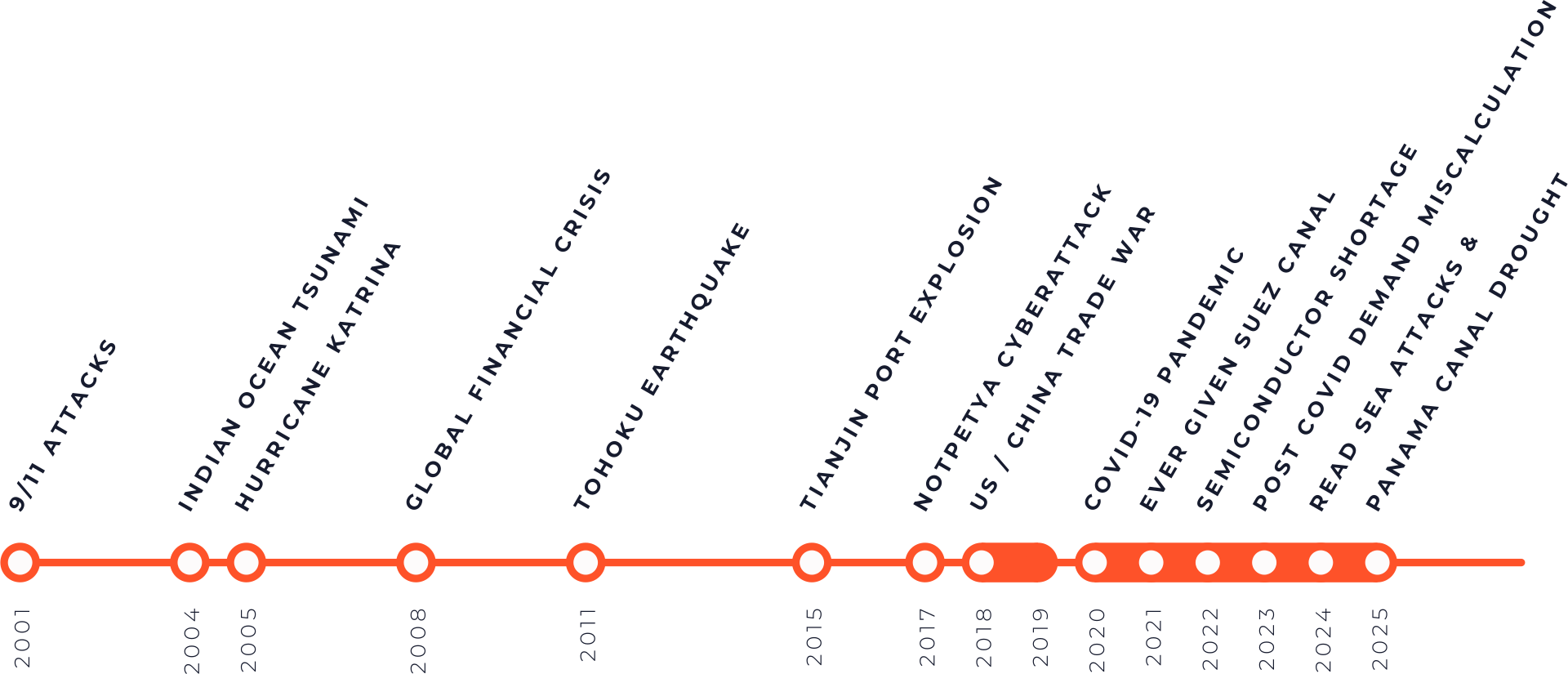
What defines performance now is not the absence of disruption, but the ability to respond without losing control of time, cost, and production schedules.
In this context, performance gaps appear faster and hesitation is punished more quickly.
Systems designed primarily for stability tend to slow down when conditions change. Systems designed for volatility can act early, limit exposure, and preserve continuity before pressure escalates.
Speed, under these conditions, changes meaning. It stops being a tactical advantage and becomes a requirement for containment.
When speed breaks down
In volatile environments, the first bottleneck is rarely physical capacity. It is governance.
When decision rights are unclear, every incident becomes a discussion. Questions circulate across teams and regions, while the first critical hour is consumed by alignment rather than action.Visibility may be high, but without authority and predefined responses, information alone does not create speed.
FAST breaks down not when movement slows, but when decisions are delayed. As delays accumulate, windows close, options narrow, and recovery becomes more expensive and more disruptive than necessary.
Speed that depends on improvisation creates urgency. Speed that is designed creates control. When authority is clear and actions are predefined, teams move faster because they know exactly what “good action” looks like under pressure.

The compounding cost of slow
Disruption is often associated with large-scale events: strikes, geopolitical tensions, regulatory changes, or system-wide shutdowns.
When these happen, the impact is immediate and visible. Industry data reflects it clearly. Deloitte has cited estimates that unplanned downtime costs industries around $50 billion annually. Reuters reporting on the 2024 U.S. East and Gulf Coast dockworker strike noted that analysts estimated losses of roughly $5 billion per day while 36 ports were affected.
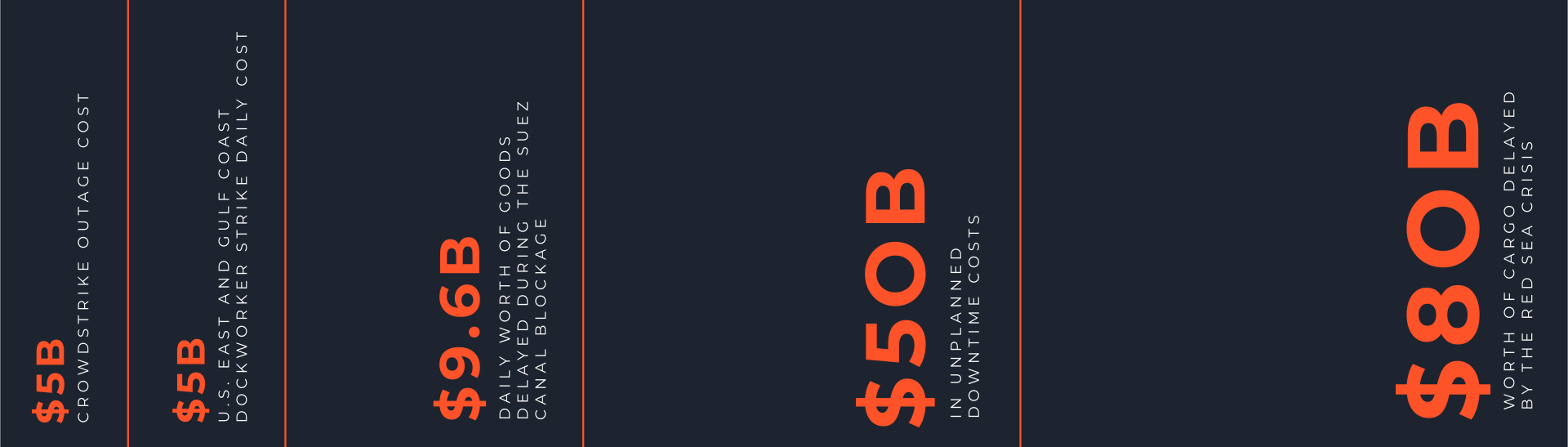
These numbers are dramatic, but the more everyday costs are the ones that quietly reshape performance, including OTIF erosion, premium-freight spikes, inventory buffers that tie up working capital, and longer mean time to recover (MTTR) after an incident.
Cargo readiness gaps are a reminder that disruption doesn’t always look dramatic. Sometimes it’s a last‑minute pallet count change, labels that don’t match the packing list, dimensions that don’t fit the booked equipment, or a missing declaration that turns a routine movement into a sudden stop, while the truck is already at the gate and the clock is running.
This is where cost truly compounds. When responses are not designed in advance, organizations do not just lose time—they lose options. Viable alternatives disappear, costs increase, and urgency replaces control. The operation shifts from managing outcomes to reacting under pressure.
When speed becomes a system
Speed does not appear in the moment of disruption. It is designed long before urgency arrives.
Organizations that respond faster under pressure do not rely on heroic effort or last-minute acceleration. They rely on systems built to function when plans break.
In practice, this means removing ambiguity before it matters. Decision authority is defined in advance, not negotiated mid-incident. Escalation paths are clear, time-boxed, and understood across teams. Actions are triggered by predefined signals, not delayed by alignment cycles. When conditions shift, the system already knows who decides, what options are available, and how quickly action must follow.
That system is documented, tested, and enforceable.
It lives in SOPs that remove guesswork under pressure and in SLAs that define response expectations across teams, time zones, and partners. When disruption hits, the system does not pause to renegotiate. It follows pre-agreed rules that protect time, options, and continuity.

Consider a production ramp-up.
In one scenario, demand is pulled forward and teams scramble to confirm inbound availability across suppliers and lanes. Approvals bottleneck, escalation drags, and decisions arrive late, when the only transport options left are expensive and disruptive.
In another, ramp-ups are treated as a known disruption pattern. Triggers are predefined, decision cycles are time-boxed, and alternatives such as split shipments or reserved capacity are pre-approved. Action happens while options still exist.
The same contrast appears inside the plant.
A critical component misses its inbound window. Without a designed response, teams wait for updated ETAs, escalate across time zones, and choose the most expensive option late, after downtime is already on the table. With a system in place, escalation is immediate, authority is clear, and predefined alternatives are activated before the schedule breaks.
This is where many organizations overestimate their readiness. Visibility helps, but visibility alone does not create speed. Dashboards do not replace authority. Alerts without predefined actions add noise instead of clarity. When technology is layered onto unclear governance, responses slow rather than accelerate under pressure.
FAST, as a capability, is built through design. Through protocols that allow action without negotiation. Through scenarios that anticipate deviation instead of assuming stability. Through alternatives approved in advance, so teams can move while options still exist, not after they have disappeared.
This is what operational resilience looks like in practice.
Not the absence of disruption, but the ability to absorb it early, protect production continuity, and recover without cascading damage when conditions shift.
FAST is not a promise made in calm conditions.
It is a system that holds when conditions are not met.
HOW CAN YOU CHOOSE THE BEST TRANSPORT MODE WHEN A SHIPMENT BECOMES URGENT?
The xpd global standard of FAST
After every disruption, the same question emerges.
Was speed fast enough, or did urgency take control before decisions were made?
Most organizations still talk about speed as something that happens only after disruption becomes visible. After the alert. After the delay. After the plan has already broken.
Under the FAST standard we operate by, speed starts earlier than that.

It begins at the moment conditions start to shift, before urgency dictates behavior and before options collapse. That is where speed actually matters, and where many operating models fall short.
This is the line that separates reaction from control.
Under this standard, logistics changes its role. Speed stops being a function of transport and becomes a capability that protects continuity under pressure.
This is the FAST standard xpd global operates by and holds itself accountable to.
Not as a conclusion, but as the baseline required to support time-sensitive and critical logistics.
If you’d like to know more about our Time Sensitive and Critical Cargo capabilities designed for fast deliveries and controlled responses, explore the overview here.
Sources referenced for the data points mentioned
Deloitte — “Asset Optimization: Predictive Maintenance (Smart Factory)”:
https://www.deloitte.com/us/en/ services/consulting/services/predictive-maintenance-and-the-smart-factory.html
Reuters — U.S. dockworker strike affecting 36 ports; analysts estimate ~$5B/day losses (Oct 2024):
https://www.reuters.com/world/us/ship-queue-grows-us-ports-dockworker-strike-enters-third-day-2024-10-03/